
At the end of last year, we started a 6 week pilot project with The Heart Centre in Woking. The Stability project brought displaced young people together with horses in a programme built around systemic coaching, horsemanship and language training, with a therapeutic focus on self-esteem, communication and coping strategies.
The young people invited had been finding their resettlement particularly difficult; left in limbo by the Home Office, facing life in an entirely new culture, trying to digest what had gone before, they were anxious, disengaged and lacking in hope.
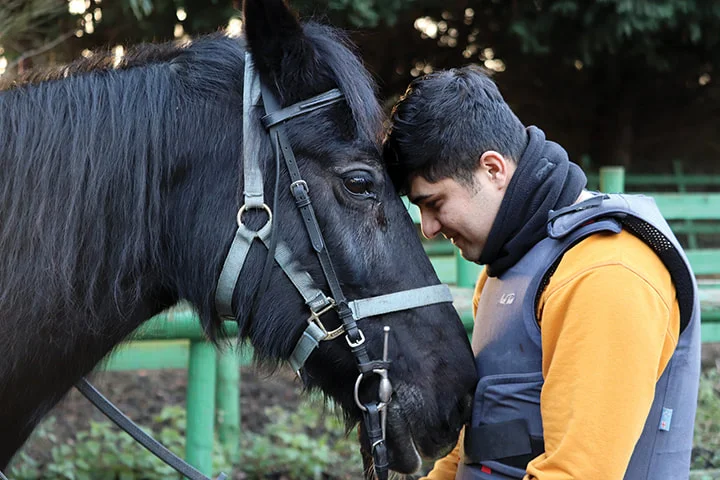
We wanted to create space for a trusting relationship to develop between person and horse which could be the catalyst for renewed reflection, increased self-confidence and an ongoing sense of stability in life.
And as isolation, boredom and uncertainty were major challenges of their daily life, the structure of the project was simple. Once a week, for six weeks, they came to the stables to be with the horses. They learned how to feed and water them, how to groom them and pick their hooves; they discovered how to recognise if the horses were upset, and how to communicate in response. But most of all, they learned to build trust.
The evidence that horses can play a significant role in creating a response to complex distress is compelling, and we had already seen it in action during our summer camp at Trill Farm. For young people who have had to leave their homes and make treacherous journeys with no guarantee of success, the post-flight phase can be overwhelming. Thoughts about what has happened, what is happening now, and what is still to come can be impossible to untangle.
Horses invite communication, but they are not demanding of words and this removes the pressure of having to articulate the impossible. At Stability, young people were encouraged to talk to the horses, using any language they liked. Mihael told us his horse understood Kurdish very well, although when we asked what they had been chatting about, he told us that it was private. A listening, non-judgemental ear can be a very good thing, but it is something these isolated young people do not easily find here.
It is significant that many of the horses here are rescued from neglect and abuse, and this is not lost on anyone. Explaining this briefly to Jalal while he groomed his mare, he said “Yep, like me” and put his face against her nose.
Trust is a central focus of the project. The very first time anyone gets up on the horse, they do it blindfold, and without a saddle. At this point, there is nothing between horse and rider except trust, and although everyone was apprehensive at the thought of riding a horse without being able to see, they all did it, and they were jubilant afterwards.
By the end of the pilot, the difference between the first and final days was marked; where they had been withdrawn and anxious, they were now engaged and relaxed. And this lasted beyond the confines of the stables. One key worker wrote to us to say how much better their relationships had become with each other, and how much more positive they seemed. A college tutor told us about the increased confidence in one young person and his new enthusiasm for English.
The flip side of this was of course that we were soon inundated with pleas from other young people and key workers for places on the project, and therefore the clear task was to turn the pilot into a robust and regular programme to be offered to a wider audience.
And so we could not be more grateful for the funding from Guildford Philanthropy which now enables us to do this. With the incredible generosity we can now run Stability five times a year, allowing us to reach a much greater number of young people in Surrey. Thank you to you all for helping us provide Stability to help these young people find their feet, find their confidence and find their hope in a positive and secure future in the UK. We couldn’t be more grateful.
Kayte Cable
Co-Founder and Projects Manager
